Under Stair Storage Ideas on a Budget (12 Ideas)
The space under the stairs is the most wasted square footage in most homes. It is awkward — low, deep, dark — so it becomes a graveyard for the vacuum, the wrapping paper, and the box of cables nobody can throw away. But that triangle is real storage — often six to ten square feet — sitting empty.
The twelve ideas below turn it into storage you actually use: a pantry, a closet, a desk, a reading nook, a mudroom. Most cost under $100, several cost under $25, and every idea has a no-damage version for renters.
The Rules for Under Stair Storage That Actually Works
Before you build or buy anything, three rules. First, measure the awkwardness: the height at the lowest end, the depth at the back, and the width between the walls decide what fits — a storage bin needs about 16 inches of height, a hanging coat needs about 40, and a desk needs roughly 48 inches of seated headroom.
Second, put daily things at the front and seasonal things at the back: anything you have to crawl for will not get used. Third, match the storage to the room — an entryway stair wants coats and shoes, a living room stair wants books, a stair near the kitchen wants pantry overflow.
12 Under Stair Storage Ideas on a Budget
Each idea works on its own. Pick the one that matches your measurements and your room.
1. Pull-Out Drawers on Casters (Under $100)
Build a shallow plywood box — or repurpose a low dresser with its legs removed — add four swivel casters, and slide it into the space. Everything inside is reachable without crawling, because the drawer comes to you. Two or three drawers side by side hold shoes, games, or off-season clothes. The casters cost about $15 in hardware and work in a space no fixed shelf ever will.
2. Open Cubby Shelves with Matching Baskets
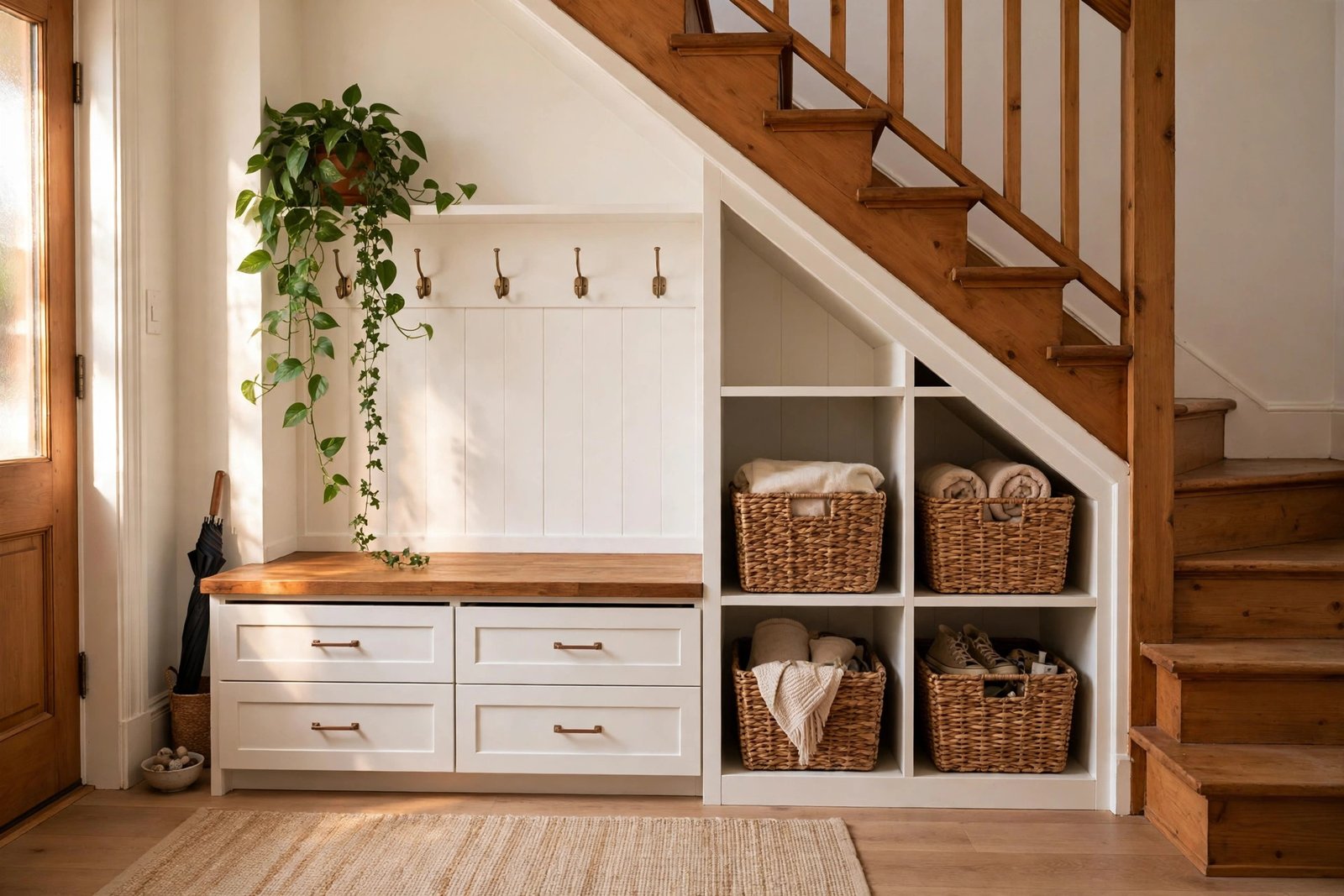
If the space is too low for a door, skip the door entirely. Cut two or three plywood shelves to fit the triangle, paint them the wall color, and fill them with matching baskets or fabric bins. Open cubbies keep everything visible, and the matching baskets keep open storage from looking like a mess. Label the front of each basket: winter gear, gift wrap, board games, pet supplies. Six matching bins cost about $20 to $30. Our best storage bins for closet organization roundup covers which bins hold up and which ones sag.
3. A Hidden Coat Closet with a Door
When the space is tall enough for a coat — about 40 inches at the front — the highest-value move is a real closet. Add a tension rod or a wall-mounted closet rod, a single shelf above it, and a door: a curtain on a tension rod if you rent, a louvered or flat-panel door if you own. The door hides the visual noise and keeps dust off the coats. Total cost is about $30 to $60, and it frees the entryway closet — or replaces it entirely in a home that never had one.
4. An Under-Stair Pantry (Under $50)
If the stairs sit near the kitchen, the space underneath is a pantry waiting to happen. Line the back wall with narrow shelves — cans and jars only need 6 to 8 inches of depth — and keep the front open for bulk items: the big bag of rice, the case of water, the slow cooker. A $10 battery motion light solves the darkness, and a tension-rod curtain keeps the pantry tidy from the kitchen. Before you stock it, clear the kitchen first — our room-by-room declutter guide starts with the kitchen for exactly this reason.
5. A Mini Mudroom with Hooks and a Bench
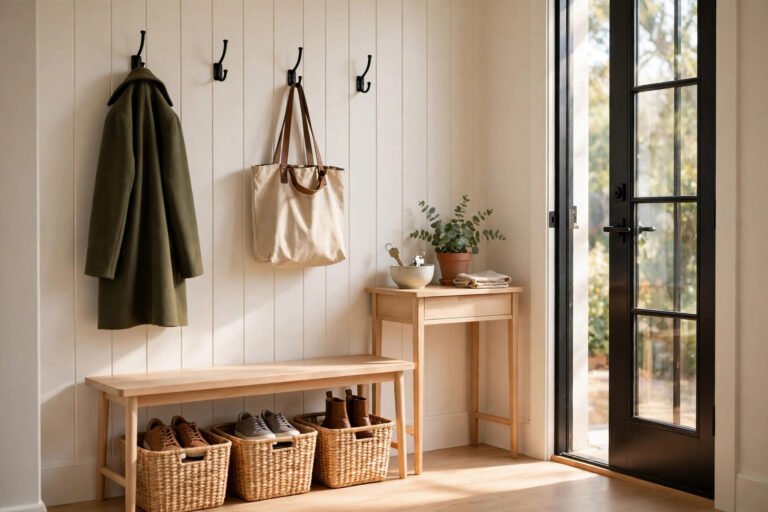
An entryway stair is a mudroom that just needs permission. Mount a row of sturdy hooks at adult and child height, set a low bench or a storage ottoman against the wall, and put a boot tray underneath it. The bench gives everyone a place to sit while they put shoes on, and the space under the bench holds the shoes themselves. A small basket per person above the hooks holds hats, gloves, and keys. A set of hooks and a thrifted bench run about $40 to $70.
6. A Cozy Reading Nook (Under $75)
The low, sloped ceiling that makes under-stair space bad for storage makes it perfect for a reading nook. A thick cushion or a folded twin mattress topper on the floor, a couple of throw pillows, a small reading light, and one short shelf for the current book — that is the whole build. The enclosed feeling is the point: kids love it, and adults do too once they try it. Cost is $50 to $75 if you buy the cushion new, under $25 if you repurpose pillows and a spare blanket.
7. A Compact Home Office Nook (Under $100)
Remote work turned the space under the stairs into the smallest home office in the house. A wall-mounted folding desk — or a shelf board on brackets at desk height — fits a laptop, and a stool tucks underneath when you are done. Add a small shelf for a notebook and a charger, a clip-on light, and a power strip. A folding wall desk costs $40 to $80, and a shelf-and-brackets version is under $30. Our small home office makeover on a budget covers the same setup at a larger scale.
8. Toy Storage with Labeled Bins (Under $50)
Under-stair space is the right size for toys in a way a playroom never is: big enough for the building blocks and the dress-up box, small enough that it cannot become a second playroom. Low open shelves with labeled bins — one bin per type of toy, labels with pictures for kids who cannot read yet — mean cleanup is a game instead of a chore. Six labeled bins and two shelves run about $40 to $50, and the room above the stairs stays a living room instead of a toy store.
9. A Wine Rack or Mini Bar Zone (Under $75)
The cool, dark space under the stairs is naturally suited to bottles. A wall-mounted wine rack holds a dozen bottles in the space of a picture frame, and a small cart or narrow console underneath holds glasses, a bottle opener, and a cocktail book. If you do not drink wine, the same setup works as a coffee or tea station: mugs on hooks, a small electric kettle, and the good beans. A wall rack and a thrifted cart run about $50 to $75.
10. A Pet Nook with Bed and Bowls (Under $40)
Dogs and cats love enclosed spaces, and the space under the stairs is the den they would choose themselves. A washable dog bed or a cat cave at the back, food and water bowls on a small raised stand at the front, and a hook for the leash and the treat bag — that is the whole build. The pet nook costs about $20 to $40 for the bowl stand, the hooks, and the curtain, and it gets the food bowls out of the kitchen walkway.
11. A Bike and Sports Gear Zone (Under $60)
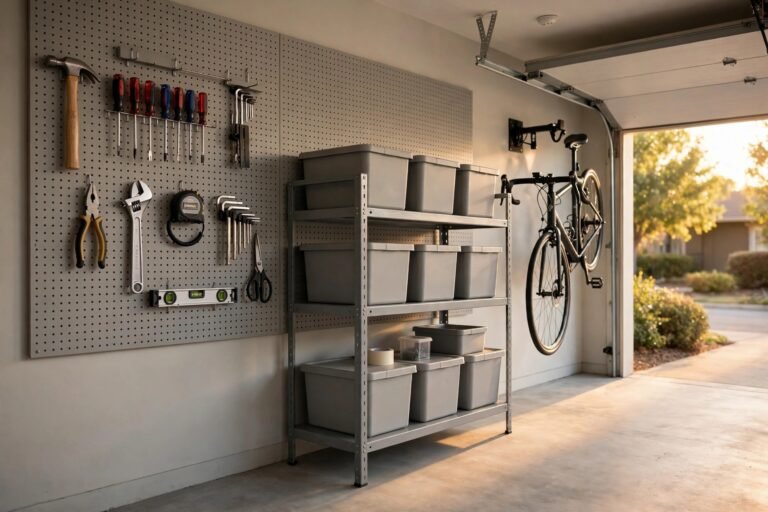
Sports gear is the hardest thing in a house to store, because it is long, awkward, and always in the way — and the space under the stairs is long and awkward in exactly the same shape. A vertical wall hook holds a bike by its front wheel, heavy-duty hooks hold helmets and backpacks, and a tall narrow bin holds bats, rackets, and umbrellas. One bike hook is about $15, a set of heavy-duty hooks about $20, and the whole zone is under $60.
12. A Display Shelf for Books and Plants (Under $30)
Not every under-stair space needs to hide things. Sometimes the best use is showing them. A few floating shelves cut to the slope of the stairs, styled with books, a trailing plant, and one or two objects you love, turn the dead corner into the prettiest spot in the room. Keep it to three objects per shelf and leave breathing room between them. Two floating shelves and a plant cost about $25 to $30. Our small space storage furniture ideas roundup covers pieces that store and display at the same time.
How to Build Under Stair Storage in One Weekend
Start Saturday morning with measuring and clearing: measure the height, depth, and width at three points, then pull everything out and sort it into keep, move, and donate. Saturday afternoon, build or buy the shelves, drawers, or hooks, and install the lighting first so you can see what you are doing. Sunday is for stocking: daily things at the front, seasonal things at the back, labels on every bin.
The Mistakes That Make Under Stair Storage Look Like Clutter
The most common mistake is blocking access to what is already under there. Water heaters, electrical panels, and shut-off valves live under stairs and need clear access — never build fixed shelving in front of them, and keep at least three feet of clearance. The second mistake is storage too deep to reach: anything past arm’s length becomes a black hole, so use pull-out drawers. The third is no lighting. The fourth is overstuffing: if the door will not close, take something out.
FAQ
How much does under stair storage cost on a budget?
Most under-stair storage costs $25 to $100: open shelves with baskets are about $30, pull-out drawers are about $60 to $100, and a coat closet is about $30 to $60. The cheapest options — a reading nook from pillows you own, a pet nook from a spare bed — cost under $25.
What can I store under the stairs?
Almost anything that fits: coats and shoes, pantry overflow, cleaning supplies, board games, toys, sports gear, books, and seasonal decorations. Keep daily-use items at the front, seasonal items at the back, and never block a water heater, electrical panel, or shut-off valve.
Do I need a permit to build under stair storage?
Simple storage — shelves, drawers, hooks, and freestanding furniture — does not need a permit. If you frame in a closet with a door, add wiring, or move plumbing, check your local building code first: enclosed spaces under stairs have fire-blocking and access rules in many areas.
How do I keep under stair storage from looking cluttered?
Use matching baskets or bins, label everything, and add a door or curtain so the storage reads as one tidy surface from the room. Keep one-third of every shelf empty, put a light inside, and take something out whenever the door will not close.