DIY Small Closet Organization: Double Space for Under $50
Small closets aren’t actually short on space — they’re short on structure. One rod, one shelf, and a floor pile is the default setup in most homes, and it wastes roughly half the closet’s volume. The DIY fixes below add structure where the builder didn’t, and the whole overhaul lands under $50. Most of them need no power tools and no landlord permission.
The Audit: Empty It First (Free, 1 Hour)
Take everything out. Yes, everything. Then:
- Sort into four piles: keep in this closet, relocate to another room, donate, trash.
- Count what you actually store: how many hanging items? How many pairs of shoes? How much shelf stuff? You’re designing for your inventory, not a catalog photo.
- Wipe down the empty closet — shelves, walls, floor. You’ll never have better access.
Most people donate or relocate 20–30% in this step alone. That’s free space you already owned.
Cost: $0.
DIY Fix #1: The Second Rod ($8–$12)
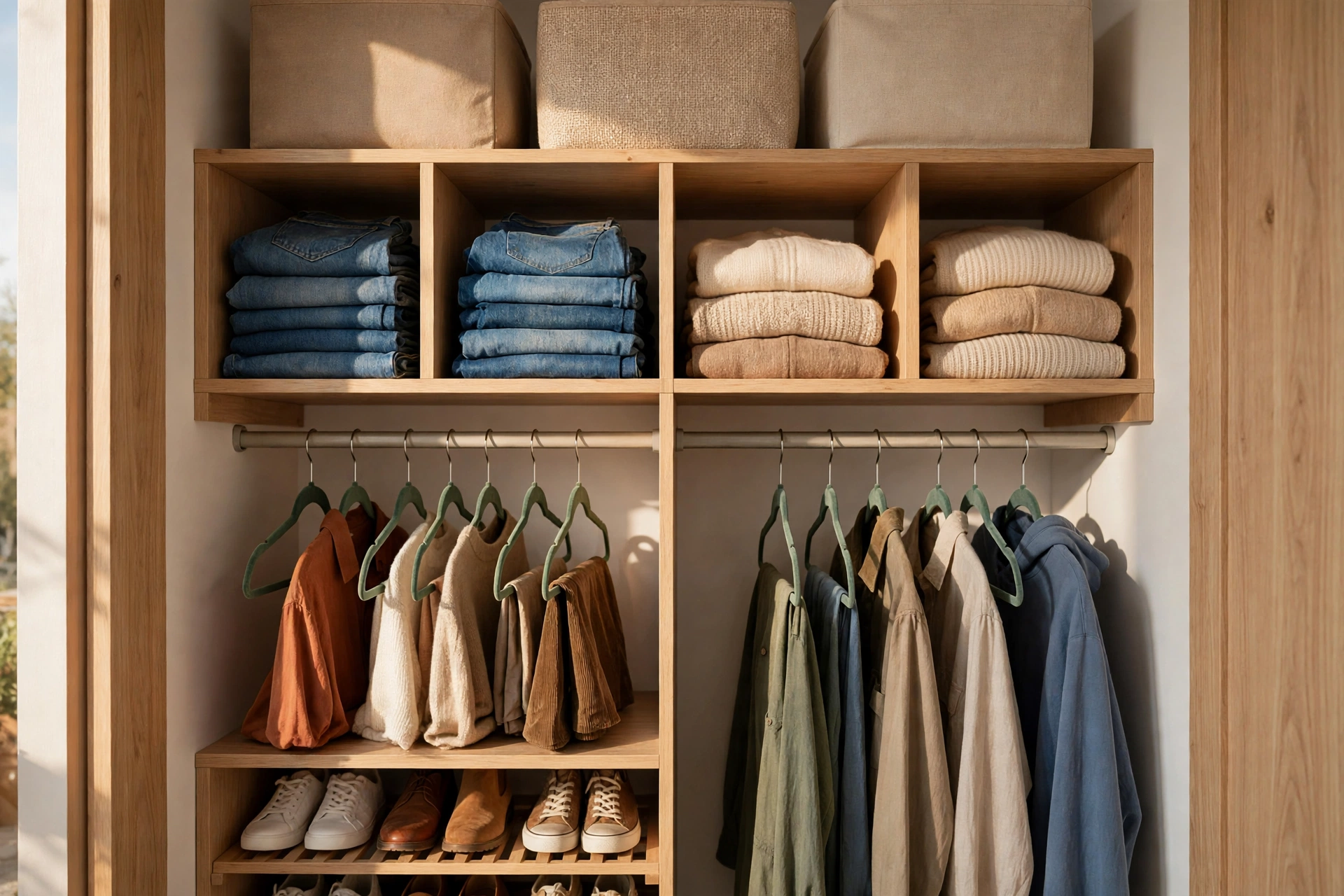
This is the highest-impact closet DIY in existence. A tension rod or hanging rod extender mounted halfway down creates a second hanging level:
- Top rod: shirts, blouses, folded pants
- Bottom rod: shorter items, kids’ clothes
- One side left full-length for dresses and coats
A $10 hanging rod doubler installs in seconds with no tools. If your closet is wide, a tension rod ($8–$12) spanning wall to wall does the same job.
Space gained: roughly doubles hanging capacity.
DIY Fix #2: Slim Hangers, All the Way ($12–$15)
I mentioned these in the bedroom guide and I’m saying it again because it matters this much: replace bulky plastic and wire hangers with slim velvet hangers (30-pack, $12–$15). The space savings are visible immediately — items stop crowding each other, and nothing slides off.
Space gained: 20–30% more rod capacity from the same rod.
DIY Fix #3: Shelf Dividers ($8–$14)
Closet shelves become landslide zones because there’s nothing stopping stacks from toppling. Fix it:
- Acrylic or wire shelf dividers ($8–$14 for a set) clip onto the shelf and create cubbies. Folded jeans in one cubby, sweaters in another, bags in a third.
- The free version: cut cardboard boxes to shelf height as dividers, covered in contact paper. Works perfectly, costs nothing.
Fold using the file-fold method (standing upright like files in a drawer) instead of stacking — you can see every item, and nothing gets buried.
DIY Fix #4: The Door Is Storage ($10–$18)
- Over-the-door shoe organizer ($8–$12): the classic. But skip shoes if you want — these pockets are perfect for accessories, scarves, belts, sunglasses, and small bags.
- Adhesive hooks inside the door ($4–$6 for a pack): tomorrow’s outfit, robes, frequently grabbed bags.
- A hanging mirror on the door ($10–$15): doubles as a full-length mirror and keeps wall space free elsewhere.
DIY Fix #5: Floor-Level Fixes ($5–$15)
The closet floor is where shoes go to die. Systems:
- A two-tier shoe rack ($12–$18) doubles shoe capacity in the same footprint. Measure your closet depth first — standard is fine for most.
- Boot shapers ($6–$10 for a set): pool noodles cut to length work identically. Boots stand up, keep their shape, and take half the floor space of flopped-over boots.
- A low bin for the “floor pile” ($5–$8): laundry, returns, gym bag — one designated bin so the floor never becomes the default.
DIY Fix #6: Top Shelf Rescue ($10–$20)
The top shelf is where things go to be forgotten. Make it functional:
- Uniform bins with labels ($10–$20 for a set of 3–4): off-season clothes, costumes, gift wrap, memorabilia. Label the front so you can read it from below.
- The step-stool rule: keep a folding step stool ($12–$18) in or near the closet. If the top shelf requires a chair-dragging expedition, you’ll never use it properly.
Seasonal Rotation: The Twice-a-Year Habit
Small closets can’t hold all seasons at once. Twice a year (October and April are perfect), swap:
- Current season moves to prime rod/shelf real estate.
- Off-season goes into labeled bins on the top shelf or under the bed (vacuum bags, $8–$12, compress bulky coats dramatically).
The swap takes 30 minutes and the closet always feels “right” for the weather.
Full Budget Breakdown
| Fix | Cost |
|---|---|
| Audit + declutter | $0 |
| Second rod | $8–$12 |
| Slim hangers (30-pack) | $12–$15 |
| Shelf dividers | $0–$14 |
| Over-the-door organizer | $8–$12 |
| Shoe rack | $12–$18 |
| Top-shelf bins | $10–$20 |
| Total | $50–$91 |
Hit a hard $50 by: doing the cardboard divider version (free), skipping the shoe rack (use the door organizer for shoes), and buying bins at the dollar store.
The Capsule Tie-In: Fewer Clothes, Calmer Closet
Here’s the advanced move: a small closet stays organized effortlessly when it holds fewer things. You don’t need a strict capsule wardrobe, but borrowing the principle helps enormously:
- The 80/20 audit: most people wear 20% of their clothes 80% of the time. During your audit, notice which items you reach for — those earn prime rod space. The rest goes to secondary storage or donation.
- One color family: when most of your wardrobe shares 2–3 base colors (navy, cream, olive, whatever you love), everything matches, getting dressed takes seconds, and the closet looks calmer even when full.
- The hanger trick: turn all hangers backward. When you wear something, hang it back normally. After 3 months, anything still backward goes. Brutal, effective, free.
A smaller wardrobe in an organized small closet beats a big wardrobe in chaos every time — and getting dressed each morning becomes genuinely enjoyable instead of stressful.
How often should I declutter my closet?
The seasonal rotation (twice a year) handles the big purge. Between rotations, the one-in-one-out rule prevents growth. If you do both, you’ll never need another massive closet cleanout — the system maintains itself.
My closet has sliding doors — do these ideas still work?
Yes, with one adjustment: over-the-door organizers don’t fit sliding doors, so move that storage to the walls beside the closet (hooks, a slim shelf) or inside on the side walls. Everything else — second rod, slim hangers, dividers, bins — works identically.
FAQ
How do I organize a small closet with no built-ins?
The rod + door + floor system above is your built-in. Tension rods, over-door organizers, and freestanding shoe racks create structure without a single screw — ideal for rentals.
What’s better: more hanging space or more shelves?
It depends on your wardrobe. Lots of shirts and pants → prioritize the second rod. Lots of folded knits, bags, and shoes → prioritize shelf dividers and bins. Audit first, buy second.
How do I keep my closet organized after the overhaul?
The one-in-one-out rule for clothes, plus a 5-minute weekly reset (Sunday night works). Small closets drift fast — a tiny regular habit beats a big annual purge.
Are closet organization systems worth it?
The $200+ modular systems are great if you own your home and have the budget. But the $50 DIY version here achieves 80% of the result. Start DIY; upgrade later if you outgrow it.