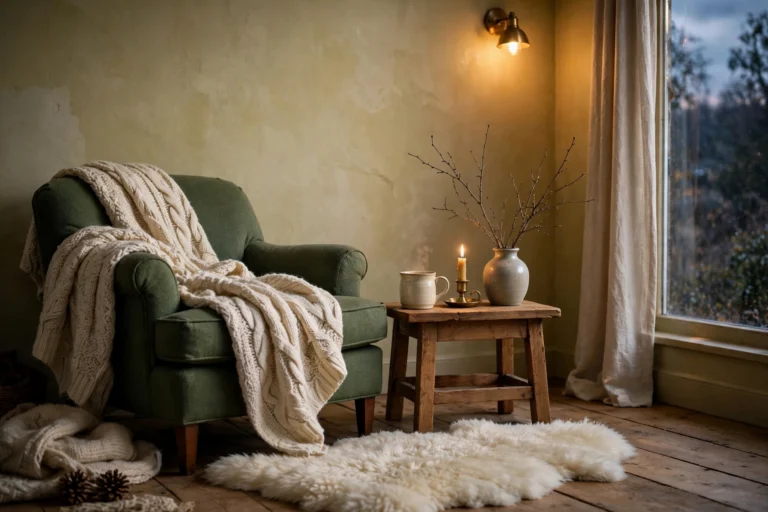
Christmas Decorating Ideas on a Budget (Small Home)
Answer capsule
Decorate a small home for Christmas on a budget by decorating one room first — usually the living room — and spending where eyes land: the tree, the mantel or focal wall, and the front door. A $25 plan covers warm-white fairy lights, a dollar-store wreath refresh, and paper ornaments. A $75 plan adds a 4-foot pre-lit tree (about $29.99 at Walmart, about $24 for a 4-foot Wondershop tree at Target, checked 26 November 2026) and a few keeper ornaments. A $150 plan adds a second focal spot, better garland, and pieces you will reuse for years. Shop your home first, keep to one colour story, hang up instead of out, and use renter-safe hooks so nothing is drilled and nothing bulky needs storing in January.
Why a small home needs a different Christmas plan
A small home does not need a seven-foot tree and a car full of decorations to feel like Christmas. It needs a few well-chosen touches in the places you actually look: a little tree on the side table, a wreath on the wall, fairy lights where the evening light falls. A studio, a one-bedroom flat, or a small house has no rooms, mantel, hallway, or spare closet for storage to spare — and that is an advantage, not a problem. Fewer surfaces means fewer decisions, less money spent, and a room that reads festive rather than full.
The freshest small-home Christmas guides published in November 2026 all make the same point: a small home needs touches in the places you actually look and nothing that takes up more than a tabletop or a wall. A small apartment reads holiday when four or five things go in the right places — up high, at the window, on the door frame — not when thirty things cover every surface. One strand of lights, a simple wreath, and a handful of handmade ornaments will carry a whole room. The cheap-decorating guides for 2026 organise ideas into $25 / $75 / $150 tiers — the same tiers this post uses, because they match how people actually shop: a little, a bit more, or a proper reset.
So this post is not a list of 21 ideas to scroll past. It is a plan. Pick a tier, pick one room, follow the five steps, and stop when the room glows. The checklist at the end is the free printable that turns the plan into a shopping list.
The one-room-first rule
Decorate one room, not the whole house. Pick the room guests see most — usually the living room — and concentrate everything there. This is the single highest-value decision in the whole post. If you spread $75 across five rooms, every room looks half-finished. If you spend $75 in one room, that room looks finished.
Stand in your front door and walk the path a guest walks. The first room they sit in is the room. In most small homes that is the living room, and the living room has three spots that do the work: the tree spot, the mantel or focal wall, and the front door or window. Spend there first. The kitchen gets one thing — a jar lantern on the counter, or a small wreath on a cabinet door — only after the living room is done. The bedroom gets nothing unless money is left over. The bathroom gets nothing. That sounds harsh, and it is exactly why the plan works.
One room also solves the storage problem. A small home has no attic, no garage shelf, no spare closet. Everything you buy in December has to fit in one box in January. If you decorated one room, you have one box. Buy pieces that pack flat — garland, ribbon, paper ornaments, a tabletop tree — and skip anything that only works in one spot.
Spend where eyes land
Inside that one room, spend where eyes land. There are three focal points, in this order: the tree, the mantel or focal wall, and the front door or window. Everything else is detail, and detail is where budgets die.
The tree is the ritual. Even a tabletop tree on a side table gives you the moment of switching the lights on in the evening. The mantel or focal wall is the backdrop — it is in every photo, and it is what guests look at while they sit. The front door or window is the first impression and the glow people see from outside. If your $25 only covers lights and a wreath, put the lights on the tree and the wreath on the door. If your $75 covers a tree and ornaments, the mantel gets the jar lanterns you already own. If your $150 covers a second focal spot, that spot is the window, not a second room.
Keep to one colour story. Three shades, repeated across the tree, the mantel, and the table, make a $1.25 ribbon look related to a $12 wreath. Five competing colours make expensive pieces look like a jumble sale. Pick one base — warm white lights, always warm white, never blue-white — plus one main colour and one accent. Red and gold is classic. Green and cream is calm. Burgundy and champagne is the 2026 look that keeps showing up in the fresh guides, and it works because it is dark enough to read as expensive in a small, dim room. Whatever you pick, repeat it three times in the room before you introduce anything new.
Shop your home first — the $0 step
Before you spend anything, shop your home. This is free in every sense: no money, no floor space, no storage.
Move last year’s decor to a new room. The mantel garland goes over the kitchen window. Tired tree ornaments become a bowl centrepiece. The same stuff, fresh eyes, zero dollars. Swap textiles instead of adding decorations: pull out your warmest, richest textiles — the terracotta throw, the cream knitted blanket, the deep red tablecloth you only use for guests — and put the pale summer ones away. That one swap changes the whole room before a single decoration goes up.
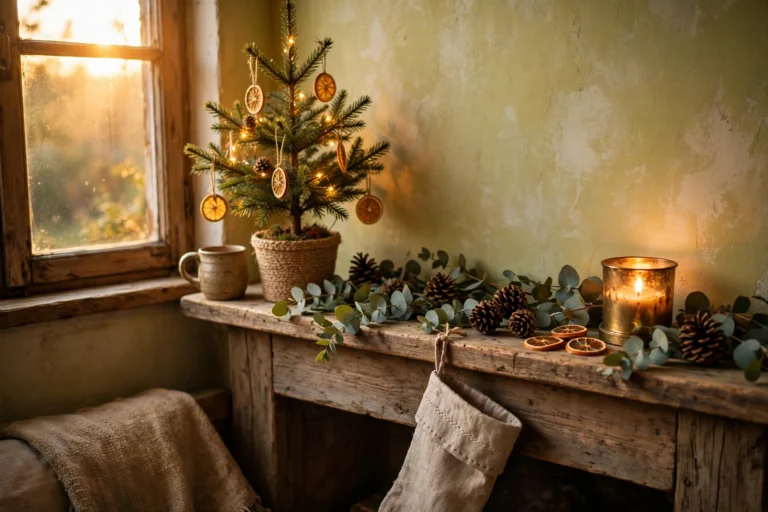
Bring the outdoors in. Pinecones are free anywhere trees exist — bake them at 200°F for 30 minutes first, then pile them in a wooden bowl with fairy lights woven through. Forage evergreen branches, or ask a local tree lot for trimmings. Dried orange slices cost about $2 to make — slice oranges a quarter-inch thick, dry them low and slow at 200°F for two to three hours, flipping once — and string them with twine between cinnamon sticks and bay leaves. Paper stars and snowflakes are free: fold them from scrap paper, old envelopes, brown parcel paper, or last year’s wrapping paper, and hang them in the window on thread at different heights.
Audit what you already own. Open the Christmas box, lay everything out, and throw away anything broken, tangled beyond saving, or in a colour you no longer use. A small home cannot afford to store decorations you do not love. If you have lights, test them now, not on the evening you plan to decorate. If you have a wreath, refresh it with a new bow instead of buying a new one.
Size the tree to the room, not the season
The tree is the one purchase that quietly decides how the room works for a month, and the honest answer in a small home is usually smaller than the heart wants. Size it to the footprint you can actually spare — measured, not guessed.
| Tree size | Where it fits | Floor it takes |
|---|---|---|
| 2–3 ft tabletop | Desk, console, dresser, dining table | None — it sits on furniture you already own |
| 4–4.5 ft floor tree | One corner, beside the sofa, in front of a window | About 2 ft across — roughly one chair’s worth |
| 6 ft and up | Only if you have a clear corner and a clear walkway around it | A full corner, plus the walking lane — usually too much in a small home |
A 4-foot pre-lit tree is the sweet spot for most small homes. Checked 26 November 2026, a Best Choice Products 4-foot pre-lit tree was $29.99 at Walmart (was $53.99), and a Wondershop 4-foot Alberta Spruce pre-lit tree was $24 at Target, with a 3-foot version at $21. Those are sale prices and they move — check before you go — but they show the range: a small pre-lit tree is a $25–$30 buy, not a $100 buy, and it comes back out next year. A tabletop tree is cheaper still: a miniature artificial tree runs about $10–$25, or less for a potted pine from a nursery, with paper and ribbon ornaments adding about $2–$5.
If even a 4-foot tree does not fit, do not force it. A garland over the door frame plus lights delivers the same green-and-warm feeling at zero floor cost, and a branch in a jar on the table — decorated with paper stars and a string of fairy lights — is a real tree in every way that matters. The rule is simple: when the wall next to the door has less than 3 feet of clear width, a floor tree does not fit without taking the walking lane. Choose the garland.
The $25 plan — lights, a wreath, and paper
This is the plan for a first apartment, a tight month, or a home that already owns a tree. It works because it spends on light first, and light is what makes a room read as Christmas after dark.
- Warm-white fairy lights, $2–$4. A 33-foot strand of warm-white battery fairy lights costs $2–$4, and a Walmart strand was listed at $4.97 in the guides checked for this post. Battery-operated means no socket and no wire trailing across the floor. Put one strand on the tree, and if you have a second, run it along the curtain rod or wind it through a garland. Warm white only.
- A wreath refresh, $3–$7. Buy the plainest faux wreath you can find — Dollar Tree or Walmart, $5–$7 — or refresh the one you own with a big velvet bow. A 10-yard spool of 2.5-inch wired velvet ribbon runs $4–$6 at Michaels, less with coupons, and one spool makes about six big bows. Hang the wreath on the front door or on a bare living-room wall, where it becomes the focal point without taking any floor at all. A ready-made evergreen wreath runs about $8–$20; making one from market greenery, wire, and ribbon runs about $5–$10.
- Paper ornaments, $0–$5. Fold stars from gold paper, cut snowflakes from white card, or thread dried orange slices on a ribbon. A bag of shatterproof ornaments from Dollar Tree — six for $1.25, grab two bags — threaded onto floral wire or sturdy twine makes an ornament garland for about $5 that drapes over a doorway or along a stair rail.
- A jar lantern, $3. Fill a mason jar (Dollar Tree, $1.25) with a string of battery fairy lights ($1–$2) and tie a velvet ribbon bow around the neck. Line three down a mantel or windowsill and you have the cosiest corner in the house for under $10. One LED string light plus one glass canning jar at Dollar Tree was $1.50 each in an October 2026 price check — $3 total for a lantern that comes back every year.
$25 total, roughly: lights $4 + wreath refresh $5 + paper ornaments $3 + jar lanterns $6 + ribbon $5, with a couple of dollars left for batteries. If you already own lights, spend the saving on a second strand or a better bow. Do not spend it on a fourth room.
The $75 plan — the $25 plan, plus a tree and keepers
The $75 plan is the $25 plan with a tree and a few pieces you will keep. It is the plan most small homes should aim for, because it is the first tier where the room looks finished rather than started.
- Everything in the $25 plan, about $25. Lights, wreath, paper ornaments, jar lanterns. Do not skip this layer — it is the glow, and the tree alone without it looks bare.
- A 4-foot pre-lit tree, about $24–$30. About $29.99 at Walmart, about $24 at Target for a 4-foot Wondershop tree. If you already own a tree, spend this $30 on garland instead — twist two six-foot dollar-store garlands together and they pass for the $60 catalogue version, for about $2.50.
- Keeper ornaments, about $10–$20. Buy three or four glass keepers in one plain finish, not twenty cheap ones in five colours. Target’s Threshold etched glass ornaments were $20 for a set of four in an October 2026 check; Walmart’s ceramic ornaments were $1.97 each. Keepers are the ornaments you will still love in three years. Everything else on the tree can be paper, pinecones, and dried oranges.
- A centrepiece, about $5–$8. A set of three flameless pillar candles was $5–$8 at Walmart or Target. Group them in odd numbers on the mantel or dining table. Or cluster pinecones in odd numbers with three cinnamon sticks tied in twine ($1.25 a pack) and let the mantel smell like Christmas, not just look like it.
$75 total, roughly: $25 base + $30 tree + $15 keepers + $5 centrepiece. If the tree is already owned, the $75 plan becomes a $45 plan — bank the difference, or spend it on a proper garland for the door frame.
The $150 plan — a second focal spot, and pieces that last
The $150 plan is for a home that wants the room to feel finished and wants the pieces to last. It adds a second focal spot — the window — and upgrades the materials, not the quantity.
- Everything in the $75 plan, about $75. Tree, lights, wreath, keepers, centrepiece. The base does not change.
- A proper garland for the door frame or mantel, about $15–$30. A real 9-foot pine garland holds its shape on two removable hooks, one at each top corner, and a faux version needs no water and packs flat into a box in January. Add pinecones, a big bow, and a few faux berries to a plain garland and it reads as a $60 piece.
- A second focal spot at the window, about $20–$30. Bottle-brush trees are the sleeper here: six Wondershop sisal bottle-brush trees were $10 at Target, and a row of them on a bookcase shelf or window ledge reads as a little forest. Add a second strand of lights along the curtain rod and a small wreath in the window, and the room glows from the outside too.
- Better textiles, about $20–$25. Swap cushion covers instead of buying new decor — two covers in your colour story, a throw for the sofa arm, a table runner for the dining table. Textiles are the fastest way to make a room feel finished, and they pack flat in January.
- One luxury, about $10. Pick one: a big velvet bow for the tree topper, a set of brass candlesticks from a thrift store (three for about $3, versus $20–$40 each new), or a tin of good cocoa and marshmallows for a hot-chocolate station on the kitchen counter. One luxury, not three. The room is already finished — the luxury is the detail people remember.
$150 total, roughly: $75 base + $25 garland + $25 window + $25 textiles, with the luxury folded in by swapping one item. If $150 is the budget, do not spend $150 on decorations and $0 on storage: a $5 flat storage box for the garland and ribbon is part of the plan, not an afterthought.
How to do it in one weekend
Total time: One weekend — about 3 hours of active work, spread across two evenings. Supplies: The tier you picked, plus removable hooks, scissors, twine, batteries, and one storage box for January.
- Step 1 — Audit and shop your home (30 minutes, $0). Lay out everything you already own, test the lights, throw away anything broken or in a colour you no longer use, and move textiles and decor to their new spots. Pick your one room and your three focal points. Write the tier on a sticky note and stick it to the fridge — that is the budget, and it does not move.
- Step 2 — Hang up, not out (40 minutes). Hang the wreath on the door or wall, run the garland over the door frame on two removable hooks, and run fairy lights along the curtain rod. Nothing on the floor yet. Nothing drilled. If a piece of decor sits on the floor, it has not been placed yet.
- Step 3 — Set the tree (30 minutes). Put the tree in its measured spot, fluff the branches, wind the lights from the inside out, then add ornaments in threes: keepers first, then paper and pinecones to fill the gaps. Top it with a big bow or a paper star. Step back and look from the doorway — that is the view that matters.
- Step 4 — Light the mantel and table (30 minutes). Cluster the jar lanterns and flameless candles in odd numbers on the mantel or dining table, add the pinecone bowl, and lay the textiles — throw, cushion covers, runner — in your one colour story. Turn the ceiling light off and the fairy lights on. If the room does not glow, you need more light, not more decorations.
- Step 5 — Photograph, pin, and pack the list (20 minutes). Take a photo of the finished room in the evening light — that is your Pinterest pin. Download the free Christmas decorating checklist below, tick off what you bought, and write the storage spot on the box before you put it away. In January, you will thank yourself.
Renter-safe, pet-safe, and fire-safe
A small home is usually a rented home, and a rented home has rules that a house does not. Use removable hooks — the kind that peel off cleanly — for garlands, wreaths, and lights. Do not drill, do not nail, and do not hang anything heavy from a curtain rod that was not built for it. If your landlord bans real candles, flameless candles are not a compromise, they are the answer: a set of three was $5–$8, they run on a timer, and they cannot set a curtain on fire.
Keep lights away from curtains and paper ornaments away from real flames. Turn fairy lights off when you leave the house, or put them on a timer plug. Keep pinecones and dried oranges out of reach of dogs that chew — cinnamon sticks and orange slices are not toys. And keep the tree stable: a 4-foot tree in a small room gets bumped. Put it in a corner, not in a walkway, and if you have a toddler or a cat, skip the glass keepers on the bottom branches and use paper and shatterproof ornaments there instead.
What not to buy
The fastest way to waste a Christmas budget in a small home is to buy the wrong things. Do not buy a 6-foot tree for a room with 8-foot ceilings and one clear corner — it will eat the room for a month. Do not buy five colours of ornaments because they were on sale — one colour story, repeated three times, beats five colours every time. Do not buy a village, a train set, or a collection of figurines — they take floor and shelf space, they need storage, and nobody looks at them after the first evening. Do not buy cool-white lights because they were cheaper. Do not buy a new wreath when a $3 bow would refresh the one you own. And do not buy decorations for rooms you have not finished yet. One room, finished, beats five rooms started.
The checklist — free printable
The free printable Christmas decorating checklist is the same plan as this post, on one page: the $0 audit, the three tiers with tick boxes, the one-room-first rule, the shopping list by store, and a storage note for January. It is free, it is printable, and it is the reason to leave an email address. No account, no app, no purchase — just the checklist, sent to your inbox.
Get the free Christmas decorating checklist (printable) — one page, three budgets, zero clutter. Join the Nest Crafted email list and we will send it to your inbox, plus the small-home decorating plan for January.
FAQ
How much does it cost to decorate a small home for Christmas?
A small home can be decorated well for $25, $75, or $150, depending on what you already own. The $25 plan covers warm-white fairy lights ($2–$4 a strand), a wreath refresh ($3–$7), paper ornaments, and jar lanterns. The $75 plan adds a 4-foot pre-lit tree (about $24–$30, checked 26 November 2026) and a few keeper ornaments. The $150 plan adds a proper garland, a second focal spot at the window, and better textiles. Prices vary by store and are before tax.
What size Christmas tree fits a small apartment?
A 2–3 foot tabletop tree fits on furniture you already own and takes no floor space. A 4–4.5 foot floor tree takes about 2 feet across — roughly one chair’s worth — and is the sweet spot for most small homes. A 6-foot tree usually takes a full corner plus the walking lane, which is too much in a small home. Measure the footprint before you shop, and if the wall next to the door has less than 3 feet of clear width, choose a garland over the door frame instead of a floor tree.
How do you decorate a small home for Christmas without clutter?
Decorate one room first, hang up instead of out, and keep to one colour story. Put decor at head height and above — wreath on the door, garland over the door frame, lights along the curtain rod — and let the floor carry nothing new. Repeat one colour three times in the room before introducing anything new, and buy pieces that pack flat for January.
Can you decorate a rented home for Christmas without drilling?
Yes. Use removable hooks that peel off cleanly for garlands, wreaths, and lights. Use battery fairy lights so nothing needs a socket across the floor. Use flameless candles instead of real ones. Dress houseplants, swap textiles, and hang paper stars in the window — none of that needs a hole in the wall, and all of it comes down without damage.
Where should I spend my Christmas decorating budget first?
Spend where eyes land, in this order: the tree, the mantel or focal wall, and the front door or window. Lights first, then the tree, then one focal piece. Do not spread the budget across five rooms — finish one room, then stop. If money is left over, the second focal spot is the window, not a second room.
Sources: InspoNest, Plant As Deco, TinyRoomStyle, FizWire, SmartTechieHome and Little Nook Home. Store prices checked 26 November 2026: Dollar Tree $1.25 items; Walmart Best Choice 4 ft pre-lit tree $29.99; Target Wondershop 4 ft tree $24, 3 ft $21; Walmart fairy-light strand $4.97; Michaels wired velvet ribbon $4–$6 per 10-yard spool; flameless candle set of 3, $5–$8 at Walmart / Target. Prices before tax, vary by store.